


January 19 is Popcorn Day, a day to organize an impromptu movie night, just so that you can enjoy a tub or two of crunchy, salty and buttery popcorn. Or, if you have a sweet tooth, treat yourself to some delicious caramel popcorn.

©iStockphoto.com/veou
The unofficial holiday is also sometimes celebrated on the day of the Super Bowl in the United States, where it is called National Popcorn Day.
Popcorn is a snack made by heating corn or maize kernels. When heated – either in a microwave oven or on the stovetop – the hull on the outside of the kernels break or “pop” creating the delicious snack we call popcorn.
Popcorn has a very long and varied history. Historians believe that corn whose kernels could be popped was first cultivated around 5000 B.C.E in Mexico. Archeologists have found evidence of first popcorn maker – a utensil with holes and a handle – dating back to 400 C.E. in Peru.
In many indigenous cultures, corn and popcorn were used for religious purposes and decoration.
Popcorn became popular in the US around the early 1900s when it was sold on street corners under the name of Pearls. Now a popular movie theater snack, theater owners initially were against serving popcorn in their premises. During the depression, however, popcorn became one of the few luxuries that people could afford forcing theater owners to start selling popcorn. Today, it is a huge part of the movie experience.
Popcorn’s fortunes fell as VCRs became popular and people started watching films at home. The invention of microwave oven popcorn and home popcorn machines once again brought popcorn into the lives of movie aficionados.
Popcorn is also often used for decoration and as packaging material.
…that popcorn is the official snack food of the State of Illinois, United States?
January 18 is Thesaurus Day. Impress your family and friends with big, complicated, and fancy sounding words to celebrate this lexicographic holiday.

©bigstockphoto.com/Simon Valentine
The unofficial holiday commemorates the birth anniversary of British lexicographer and physician, Peter Mark Roget, the author of the Roget’s Thesaurus.
A thesaurus is a book that compiles words grouped by similarity of meaning. The term thesaurus comes from the Greek word, thesauros, meaning treasure or storehouse.
Roget’s Thesaurus is one of the most widely used reference books in the English language around the world. It was first published in 1852 with 15,000 words. Since then, the book has never gone out of publication.
It is believed that Roget worked on making word lists that later became the Roget’s Thesaurus as a way to combat with depression and mental illness. Roget is also known for inventing the log slide rule in 1814. The slide rule helps calculate the roots of number very easily.
…that synonym is an antonym of antonym?
January 17 is celebrated worldwide as Benjamin Franklin Day.

©iStockphoto.com/GooDween123
Born on this day in 1706 to a soap and candle maker in England, Benjamin Franklin grew up to become one of the most well-known and celebrated Americans in history.
Ben Franklin was a polymath – someone who is an expert on a variety of different subjects. In addition to being one of America’s founding fathers, Franklin was a prolific inventor, author, printer, politician, diplomat, musician, and postmaster. The fact that he stopped attending school at the age of 10 makes him one of the most impressive person in American and world history.
Franklin was a Freemason who published several books under the pseudonym, Richard Saunders. One of his most famous works is called Poor Richard’s Almanack, an annual almanac that included poems, weather, and astrological information. For the 25 years that it was in publication – the first one came out in 1732—it was the most widely read almanac in the American colonies.
The American 100 dollar bill features a picture of Franklin. Because of this, the bills are sometimes also referred to as Benjamins.
…that the concept of Daylight Saving Time (DST) is mistakenly attributed to Benjamin Franklin? It was actually first proposed by George Vernon Hudson in 1895.
January 16 is Nothing Day, a day to celebrate, well, nothing.

©iStockphoto.com/pasicevo
Started by newspaper columnist Harold Pullman Coffin in 1973, the unofficial holiday aims to provide people “with a day where they can just sit without celebrating, observing, or honoring anything.”
The day is an “un-event”, which means that it should not be seen as an event and that one should do nothing to promote it as such.
So instead of promoting the day, we will tell you more about nothing. Nothing is an indefinite pronoun that means no thing or not anything. It refers to a person or a thing of no importance, consequence, or interest.
History is full of debates between philosophers and writers on the importance and the study of nothing. Some philosophers believe that the study of the nature of nothing is a useless endeavor since there is nothing like nothing – to answer the question, what is nothing, one must find nothing.
There is also some disagreement among physicists about the true nature of nothingness in outer space. Many claim that even a true vacuum, devoid of anything is not nothing, because even if it doesn’t have any particles of gravity, it contains quantum particles.
…that zero as a number was discovered in India in the 9th century AD?
January 15 is Strawberry Ice Cream Day. It is an unofficial holiday that celebrates ice cream made with strawberries or added strawberry flavors

©iStockphoto.com/Robert Ingelhart
It is believed that the ice cream flavor, which is now popular around the world, was invented in 1813 in the United States by First Lady Dolley Madison, and it was served during her husband, President James Madison’s second inaugural banquet at the White House.
Strawberries, a member of the rose family, were consumed by our ancestors for its medicinal purposes. The ancient Romans thought that the fruit could cure depression, sadness and kidney stones.
Modern day studies have shown that strawberries are a good source of Vitamin C and consumption of the fruit can reduce the levels of bad cholesterol in humans.
The holiday is also known as National Strawberry Ice Cream Day in the United States.
I scream, you scream, we all scream for ice cream! Strawberry ice cream to be more precise. Here are some ways to honor this hugely popular ice cream:
…that botanically, a strawberry is not a fruit at all? Instead, it is a receptacle – the thick part of a stem from which a flower grows.
January 14 get started early on this year’s spring cleaning and organizing on Organize Your Home Day.

©iStockphoto.com/Dejan Ristovski
It may sound like a lot of work, but you will thank us later. Your home will be organized, ready to receive company at a moment’s notice and more importantly, if you keep it up throughout the year, you will have an organized home next year this unofficial holiday rolls by.
Being organized can balance your life. It can reduce stress and makes you more productive. It can stop you looking for things, of having to buy new things that you don’t need. If you make it your way of life today, it can soon become a habit and you will reap the benefits for years to come.
…that cleaning can help burn calories? On average, mopping the floors for an hour will help you lose about 160 calories.
January 13 is Make your Dreams Come True Day. If you have been procrastinating on fulfilling your dream, this is your chance to get things right.

©iStockphoto.com/yaruta
This unofficial holiday with unknown origins encourages people to be proactive about achieving what they want in life.
Dreams are a part of life. We all dream when we sleep, but most of us don’t remember them the next day. No matter how big or small, there are some dreams that inspire us and allow us to make our lives better. It is these dreams that Make your Dreams Come True Day celebrates. Dreams that motivate us to do better, encourage us to take on more challenges, and energize us to succeed in our lives – professionally and personally.
…that according to experts, most people on average have a dream every 90 minutes?
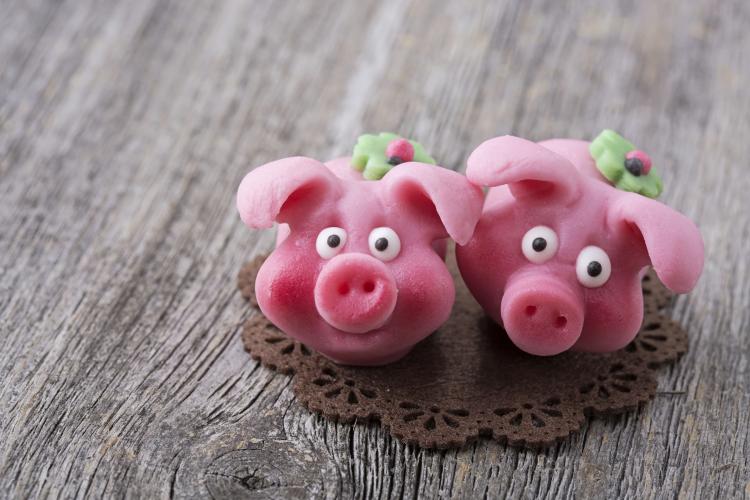
Celebrate marzipan, the sweet, almond-based multi-purpose confectionary on January 12, Marzipan Day.
©iStockphoto.com/egal
Marzipan is one of those food items that evoke extreme reactions. Love it or hate it, it is one of the most well-known and widely used food item in kitchens and bakeries around the world.
Made of almond meal and sugar, marzipan is usually used to decorate cakes. Its dough-like consistency makes it an ideal material to make novelty shapes and figures.
Some historians believe that marzipan has Arabic roots, while others believe that the Chinese introduced it to the world. Either way, it has now become the mainstay of holiday and wedding celebrations in many parts of the world.
…that the wild varieties of almond are not fit for human consumption? This is because they contain a compound called glycoside amygdalin, which turns into hydrogen cyanide if the seed is crushed or injured.
January 11 is celebrated annually as Learn Your Name in Morse Code Day

©iStockphoto.com/Studio-Annika
Morse code is a way to transmit text through a series of signals. Each character or alphabet in a language is represented by a sequence of dots and dashes.
First demonstrated on January 11, 1838 by Alfred Vail and Samuel Morse, Morse code soon became commonly used by the military and the aviation industry worldwide.
Until 1999 the distress signal “SOS”, or “··· – – – ···” in Morse code, was used to communicate distress by ships and naval vessels around the world. Although it does not stand for anything it has been remembered as “Save Our Souls” or “Save Our Ship“.
It was replaced by the Global Maritime Distress Safety System in 1999, but is still widely recognised as a distress signal today.
…that the fastest Morse code transmission was achieved by Tarry Turner in 1942? He reached a speed of 35 words per minute.
 Deborah & Munchkin's Adventures